Paradero Todos Santos: A Boutique Hotel Photographed on Film During a Hosted Stay
The Williams Agency photographed Paradero Todos Santos on 35mm and medium-format film during a hosted stay. Paradero is a boutique hotel in Todos Santos, Baja California Sur, Mexico, built in concrete and set in a desert garden with mountains behind it.
The set covers the property the way a guest moves through it. Garden paths, suites, the terrace, the pool at sunset. Some frames are color and some are black and white.
The brief
Paradero hosted us on property.
We went in to photograph the place itself. The architecture, the garden, the rooms and the light over the pool. No campaign concept and no shot list built around an ad.
Paradero is concrete walls, agave, cardon cactus and open desert sky. That material reads differently on film than on a digital sensor, and we wanted the set to look like the place feels in person.
The work, in order
Planning around the property. Every resort shoot we run starts the same way: we plan around the features that make the property what it is. At Paradero that meant the concrete architecture and the desert garden, with the mountains behind both.
Shooting on two formats. We carried 35mm and medium format. 35mm is the faster camera, suited to moving through a property, catching a person between two walls or a robe hanging in the light. Medium format is slower and more deliberate, and it suits architecture and wide views, where the frame is composed and the camera stays put.
Working the property on foot. The frames in the set show what we covered:
- The desert garden, with palms, grasses and the mountains behind
- Concrete walls and a courtyard planted with agave
- A suite window and the concrete ledge of the bath
- A terrace daybed above the garden
- Agave in bloom against the sky
- Paradero robes hanging on a concrete wall
- A woman in a white dress between the concrete walls
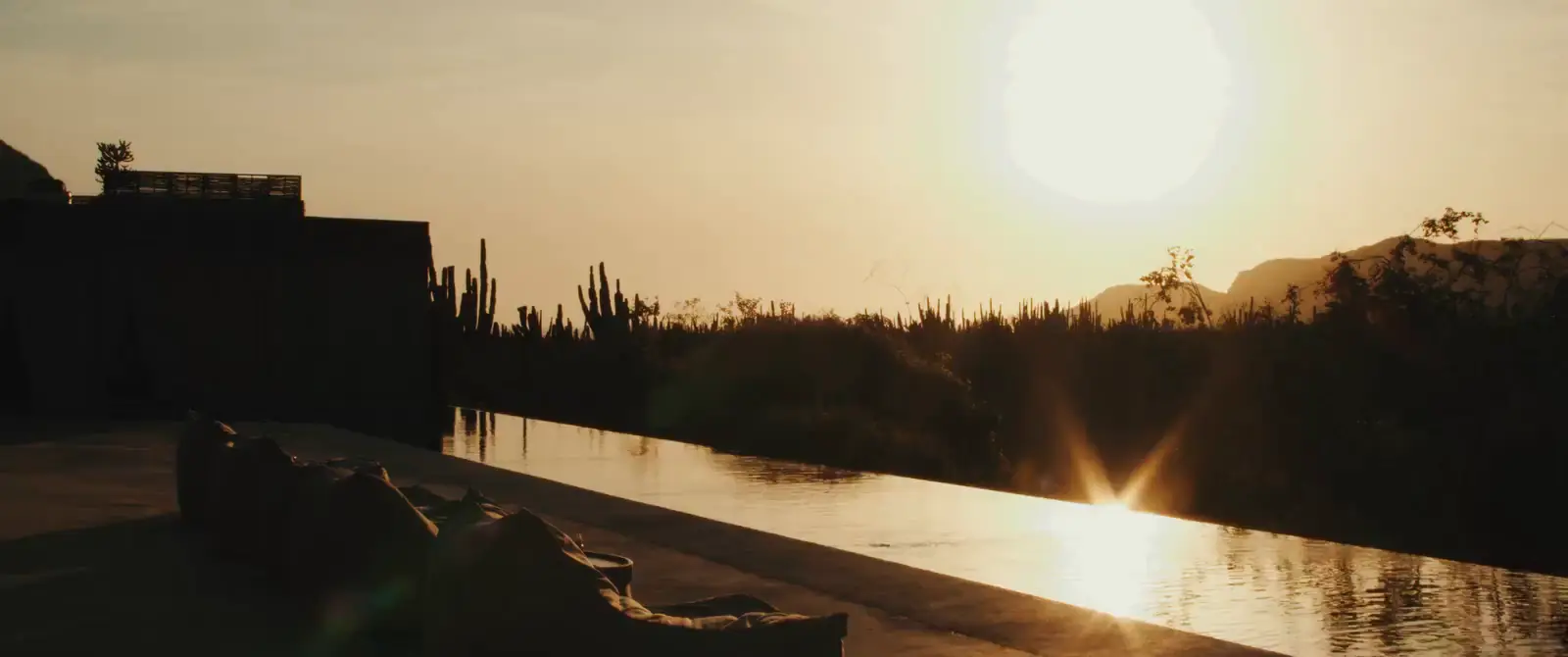
- The pool at sunset, in color and in black and white
- A cardon cactus in the garden, in black and white
- The view over the rooftops to the mountains
Lab and scans. Film does not exist as an image until it is developed. The rolls went to a lab for development and scanning, and the color is finished in the scan, not built from a preset.
Edit and sequence. We selected and sequenced the frames.
Why film for a boutique hotel
Film records light on an emulsion, not a sensor, and the difference shows up in specific places.
Grain. Grain is the physical structure of the film, so it is irregular and changes from frame to frame. Digital noise sits on a fixed pixel grid and reads as a defect. Grain reads as texture. On plain concrete and pale desert ground, it gives a flat surface something for the eye to hold.
Color. Each film stock has its own color response, fixed at the factory and finished at the lab. Sand and sky move together in one consistent direction. On digital, an editor pushes each separately, and the result often looks processed.
Highlights. Color negative film rolls off gradually into the brightest parts of a frame. A white wall in full sun or the sky over the pool at sunset keeps tone and detail where a digital file tends to clip to flat white. In desert light, that matters on almost every frame.
Medium format. The negative is much larger than a 35mm frame. Grain is finer at the same print size, and tones step more smoothly from shadow to highlight. For architecture, it gives the set a stillness 35mm does not.
Black and white. Two frames in the set are black and white film: the pool at sunset and a cardon cactus. Without color, the frame becomes shape and light, which suits a building made of concrete planes and shadow.
How it reads next to digital. Most hotel sites run on wide, bright, evenly lit listing photography. Its job is to show a room's size and layout, and it does that job. Film does a different one. Film gives hospitality imagery grain and color that read as editorial rather than listing photography.
The two sit side by side. Listing photography stays on booking pages, and film carries the homepage, the about page, the press kit and the feed. When a property also has digital video, grading it toward the film keeps the site reading as one place.
The set
Color and black-and-white film photographs of Paradero: architecture, garden, suites, terrace, pool and mountain views, and the small details a guest notices, like the robes on the wall and the agave in bloom.
What a hotel does with a film set
A film set is the layer above listing photography.
It carries the pages where a guest decides whether a place is for them, starting with the homepage and the story of the property. It gives press and travel editors frames that look like editorial, because they were made the way editorial is made. It gives social a feed that does not look like every other hotel in the region.
Stills also pair with motion. For Wings Villa at Oil Nut Bay on Virgin Gorda, our crew produced a hospitality film and drone photography. A property that wants motion and film stills from the same trip can have both. See the Wings Villa at Oil Nut Bay case study and our hospitality video production work.
If you are planning a shoot at your own property, our guide to planning a luxury resort film and photo shoot covers timing and the shot list. Our luxury resort video production and photography page covers the full resort offer.
Pricing
Projects start at $10,000. That covers planning around the property and our own crew on location, with travel built into the scope. The film, the photography or both are cut for the property's website, social channels and paid campaigns.
Do you photograph hotels in Todos Santos?
Yes. The Williams Agency photographed Paradero Todos Santos on 35mm and medium-format film during a hosted stay. We are based in Dallas and travel to properties, with travel built into each project's scope. The set covers the hotel's concrete architecture, desert garden, suites, terrace and pool at sunset, in color and black and white.
Why shoot hotel photography on film instead of digital?
Film gives hospitality imagery grain and color that read as editorial rather than listing photography. Grain is physical texture, not pixel noise, and each film stock has its own consistent color response. Color negative film also holds detail in bright highlights, like white walls in sun or a sky at sunset, where digital files tend to clip. The frames look made, not processed.
What is the difference between 35mm and medium-format film for hotel photography?
35mm is the faster format. It suits moving through a property and catching people and details as they happen. Medium format uses a much larger negative, so grain is finer and tones step more smoothly from shadow to highlight. We use 35mm for movement and detail and medium format for architecture and wide views, as we did at Paradero.
Can film photography sit next to a hotel's existing digital images?
Yes. Listing photography shows room size and layout and belongs on booking pages. Film stills carry the homepage, the property story, the press kit and social, the places where a guest decides whether a hotel is for them. When a property also has digital video, grading it toward the film keeps the whole site reading as one place rather than two separate shoots.
How much does a resort film photography project cost?
Projects at The Williams Agency start at $10,000. That covers planning around the property's key features and our own Dallas-based crew on location, with travel built into the scope. Deliverables are film stills, a hospitality film or both, cut for the property's website, social channels and paid campaigns. Multi-day shoots and larger films are scoped individually after we know the property and where the work will live.
Start a shoot
Send us your property and where the images need to live, and we will come back with a plan and a scope. Start at /contact or call 214-302-7194.